 English
 Español
  Português
  русский
  Français
  日本語
日本語  Deutsch
  tiếng Việt
  Italiano
  Nederlands
  ภาษาไทย
  Polski
  한국어
한국어  Svenska
  magyar
  Malay
Malay  বাংলা ভাষার
  Dansk
Dansk  Suomi
Suomi  हिन्दी
  Pilipino
  Türkçe
  Gaeilge
  العربية
  Indonesia
  Norsk
Norsk  تمل
تمل  český
český  ελληνικά
  український
  Javanese
  فارسی
فارسی  தமிழ்
தமிழ்  తెలుగు
  नेपाली
  Burmese
  български
  ລາວ
ລາວ  Latine
  Қазақша
  Euskal
  Azərbaycan
  Slovenský jazyk
  Македонски
  Lietuvos
  Eesti Keel
  Română
  Slovenski
  मराठी
मराठी  Srpski језик

What Is a Submerged Spiral Classifier and How Does It Improve Mineral Processing Efficiency
A Submerged Spiral Classifier is a critical piece of equipment in mineral processing, designed to separate particles based on size and density through gravity sedimentation and mechanical motion. Widely used in mining, sand washing, and industrial classification systems, this machine ensures precise particle grading, improved recovery rates, and optimized downstream processing. This article explores its working principle, structure, advantages, applications, and how companies like EPIC deliver high-performance solutions tailored for modern beneficiation plants.
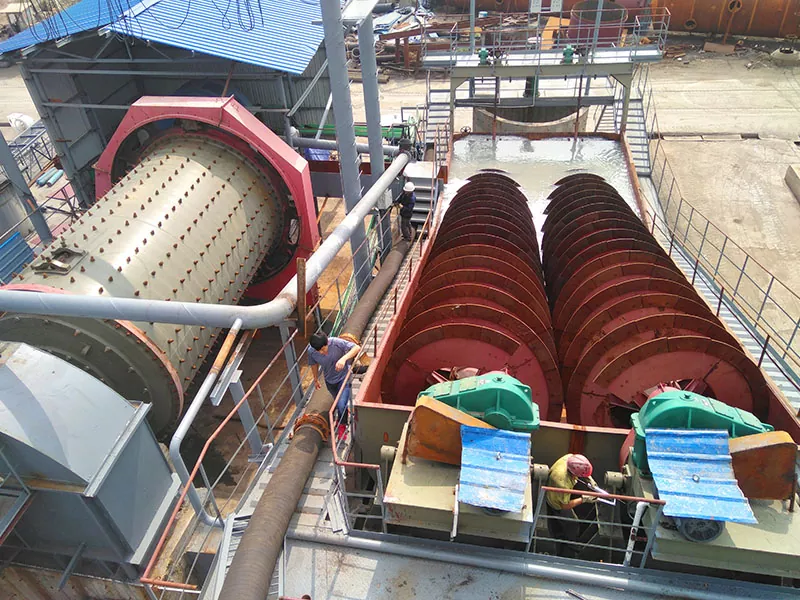
Table of Contents
- What Is a Submerged Spiral Classifier?
- How Does a Submerged Spiral Classifier Work?
- Main Structure and Components
- Key Advantages of Submerged Spiral Classifiers
- Applications in Industry
- Submerged vs High Weir Classifier
- How to Choose the Right Model
- Frequently Asked Questions
What Is a Submerged Spiral Classifier?
A Submerged Spiral Classifier is a type of mechanical classification equipment widely used in mineral processing plants. It is specifically designed for fine particle classification, typically handling materials with overflow particle sizes ranging from 0.15 mm to 0.07 mm.
Unlike traditional classifiers, the spiral in this design is completely submerged below the slurry level, allowing for more precise separation and improved efficiency when dealing with fine particles.
At EPIC, submerged spiral classifiers are engineered to deliver high-capacity processing, durability, and consistent classification performance across various mining environments.
How Does a Submerged Spiral Classifier Work?
The working principle is based on gravity sedimentation and mechanical conveying. Different-sized particles settle at different speeds in a liquid medium, enabling separation.
Step-by-Step Process:
- Slurry is fed into the classification tank.
- Fine particles remain suspended and overflow with water.
- Coarse particles settle at the bottom.
- The rotating spiral lifts coarse particles upward.
- Coarse materials are discharged for further grinding.
This process ensures efficient separation and supports closed-circuit grinding systems, improving overall plant productivity.
Main Structure and Components
The Submerged Spiral Classifier consists of several key components:
- Spiral Shaft and Blades: Transport coarse particles upward
- U-shaped Tank: Provides sedimentation area
- Drive System: Controls spiral rotation speed
- Lifting Mechanism: Adjusts spiral height
- Overflow Weir: Regulates fine particle discharge
The robust design ensures long service life even in abrasive environments, making it suitable for continuous industrial operations.
Key Advantages of Submerged Spiral Classifiers
| Advantage | Description |
|---|---|
| High Classification Accuracy | Submerged design ensures precise separation of fine particles |
| Energy Efficiency | Consumes less energy per ton of processed ore |
| Large Capacity | Handles up to tens of thousands of tons per day |
| Low Maintenance | Reduced wear and stable mechanical structure |
| Flexible Operation | Adjustable spiral speed and height |
Modern designs, such as those offered by EPIC, incorporate automation and wear-resistant materials to further enhance performance and reduce downtime.
Applications in Industry
Submerged Spiral Classifiers are widely used across multiple industries due to their versatility:
- Mining Industry: Ore classification in grinding circuits
- Sand Washing Plants: Removing impurities like clay
- Coal Processing: Fine coal separation
- Construction: Grading building materials
- Metal Recovery: Gold and precious metals beneficiation
These machines play a vital role in improving material quality and ensuring efficient downstream processing.
Submerged vs High Weir Spiral Classifier
| Feature | Submerged Type | High Weir Type |
|---|---|---|
| Spiral Position | Fully submerged | Partially exposed |
| Best for | Fine particle classification | Coarse particle separation |
| Overflow Size | Smaller (finer particles) | Larger particles |
| Efficiency | Higher for fine materials | Moderate |
Choosing between these two depends on the required particle size and process conditions.
How to Choose the Right Submerged Spiral Classifier?
When selecting a classifier, consider the following factors:
- Processing Capacity: Match equipment size with plant output
- Particle Size Range: Ensure compatibility with material characteristics
- Slurry Density: Affects classification efficiency
- Spiral Speed: Adjustable speeds improve performance
- Durability: Choose wear-resistant materials
EPIC provides customized solutions based on specific project requirements, ensuring optimal performance and long-term reliability.
Frequently Asked Questions (FAQ)
1. What is the main function of a submerged spiral classifier?
It separates fine and coarse particles in slurry, ensuring proper grading for further mineral processing.
2. Why is the spiral fully submerged?
The submerged design improves classification accuracy and prevents fine particles from escaping prematurely.
3. What industries use this equipment?
Mining, construction, sand washing, coal processing, and chemical industries all use spiral classifiers.
4. How does it compare to hydrocyclones?
Spiral classifiers are simpler, easier to maintain, and suitable for specific applications, while hydrocyclones offer higher efficiency in high-pressure systems.
5. What maintenance is required?
Routine inspection of spiral blades, lubrication of bearings, and monitoring of mechanical components are essential.
Conclusion
The Submerged Spiral Classifier remains an indispensable tool in mineral processing due to its reliability, efficiency, and adaptability. Its ability to precisely separate fine particles makes it ideal for modern beneficiation plants seeking improved recovery rates and operational efficiency.
With advanced engineering and tailored solutions, EPIC continues to lead the industry by providing high-quality submerged spiral classifiers designed for demanding applications worldwide.
If you are looking to enhance your mineral processing efficiency and achieve better classification performance, contact us today to explore how EPIC can support your project with cutting-edge solutions.
Send Inquiry



X
We use cookies to offer you a better browsing experience, analyze site traffic and personalize content. By using this site, you agree to our use of cookies.
Privacy Policy